
WiFi vs Zigbee vs Sig Mesh: Which Smart Home Protocol Is Best?
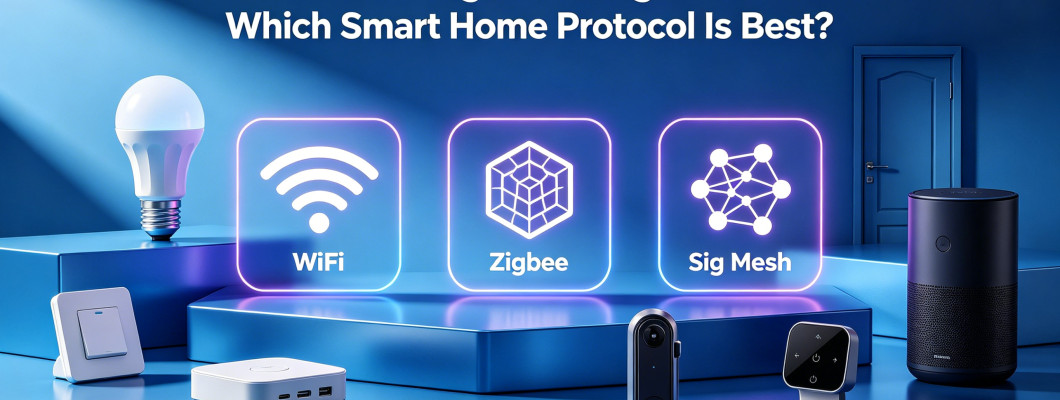
WiFi vs. Zigbee vs. Sig Mesh: Pros, Cons & Best Uses for Smart Home Devices
When building a smart home — whether for retail users, distributors, or OEM/ODM projects — choosing the right wireless protocol is critical. WiFi, Zigbee, and Sig Mesh (Bluetooth Mesh) each serve different needs in terms of power consumption, range, stability, and ease of use.
In this post, we break down the advantages, disadvantages, and ideal use cases of each protocol to help you select the best solution for smart plugs, smart switches, sensors, lighting, and automation systems.
What Is WiFi for Smart Homes?
WiFi is the most widely used wireless protocol for consumer smart devices. Most smart plugs, wall switches, and cameras connect directly to a 2.4GHz WiFi router without an extra hub.
Pros of WiFi
- No gateway or hub required
- Direct internet and app remote control
- Universal compatibility with Alexa, Google Home, and Smart Life/Tuya
- High bandwidth for cameras, speakers, and high-data devices
- Extremely easy setup for end users
Cons of WiFi
- High power consumption, not ideal for battery-powered sensors
- Router congestion when connecting many devices
- Shorter effective range in complex home environments
- Heavier dependency on cloud and internet connection
Best For
Smart plugs, wall switches, cameras, and basic smart home devices where quick setup and simplicity matter most.
What Is Zigbee?
Zigbee is a low-power wireless mesh protocol based on the IEEE 802.15.4 standard. It uses a mesh network where devices relay signals to extend coverage. A Zigbee gateway is required.
Pros of Zigbee
- Ultra-low power usage — batteries last 1–5 years
- Strong mesh network with better stability and wall penetration
- Supports up to 65,000 devices on one network
- Local automation even without internet
- High security with AES-128 encryption
Cons of Zigbee
- Requires a separate gateway / hub
- Lower bandwidth, not suitable for video or audio
- Possible interference in crowded 2.4GHz environments
- Some compatibility differences between ecosystems
Best For
Smart lighting, motion sensors, door sensors, large-scale smart homes, hotels, commercial projects, and professional B2B installations.
What Is Sig Mesh (Bluetooth Mesh)?
Sig Mesh, or Bluetooth Mesh, is an open mesh protocol developed by the Bluetooth SIG. It brings mesh networking to standard Bluetooth, offering low-power performance with smartphone-friendly pairing.
Pros of Sig Mesh
- No hub needed for local Bluetooth control
- Low power consumption similar to Zigbee
- Easy setup via smartphones
- Good scalability for lighting and sensor groups
- Wide support in mobile devices
Cons of Sig Mesh
- Shorter single-point transmission range
- Slightly higher latency in large networks
- Remote internet control still requires a gateway
- Lower bandwidth than WiFi
Best For
Smart bulbs, indoor sensors, budget smart home kits, and products focused on easy smartphone control.
WiFi vs Zigbee vs Sig Mesh: Quick Comparison
| Feature | WiFi | Zigbee | Sig Mesh |
|---|---|---|---|
| Power Usage | High | Ultra Low | Low |
| Hub Required | No | Yes | Optional |
| Network Type | Direct to Router | Mesh | Mesh |
| Range | Moderate | Long | Medium |
| Device Capacity | Limited | Very High | High |
| Ideal Devices | Plugs, Switches, Cameras | Sensors, Lighting | Lighting, Small Sensors |
| Setup Difficulty | Easy | Medium | Easy |
Which Protocol Should You Choose?
- Choose WiFi for easy-to-install smart plugs, switches, and devices for general consumers.
- Choose Zigbee for stable, low-power, large-scale smart home and commercial B2B projects.
- Choose Sig Mesh for lighting systems and sensor products that prioritize smartphone connectivity.
At TOWOSMART, we provide a full range of WiFi, Zigbee, and Sig Mesh smart home products including smart switches, sockets, relays, and sensors with OEM & ODM customization services.
If you’re a wholesaler, importer, or brand looking for reliable smart home solutions, contact us at marketing@towosmart.com for more details.
Leave a Comment